


How Is Teltonika Embedded Telematics Revolutionizing The Auto Insurance Industry?

Updated: 1 day ago
The UK auto insurance industry is under pressure from rising claim costs, fraud, and the challenge of pricing risk fairly for responsible drivers. Embedded telematics — the combination of GPS trackers and real-time data connectivity — is providing answers to all three. Teltonika GPS devices sit at the heart of this change, enabling insurers and fleet operators to build insurance products that reflect how vehicles are actually driven.

What Is Embedded Telematics?
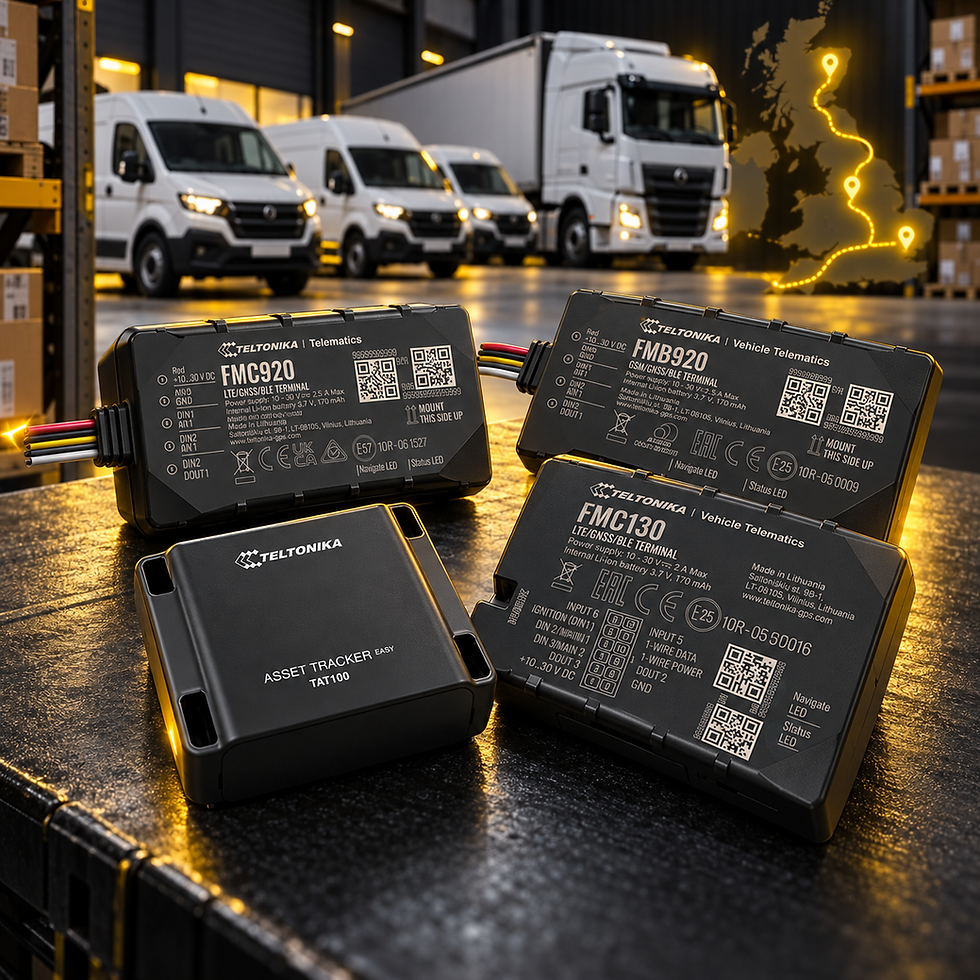
Embedded telematics refers to GPS and data-collection hardware fitted to a vehicle as a compact aftermarket device. Unlike a basic GPS tracker, an embedded telematics device collects and transmits a continuous stream of real-time data: location, speed, acceleration, braking, cornering, engine status, and — with CAN bus connectivity — fuel consumption and odometer readings. Teltonika devices such as the FMB920 and FMC920 are widely used in insurance telematics programmes for position, speed, acceleration, braking, cornering and ignition data. Neither reads CAN, so where fuel consumption and odometer readings are required insurers specify a CAN-capable model such as the FMB140, which reads CAN natively, or the FMC130 with a Teltonika CAN adapter.
Usage-Based Insurance (UBI) Powered by Teltonika Data
Usage-based insurance (UBI) prices risk based on real driving behaviour rather than traditional estimates using age, postcode, and claims history. A driver who commutes 3,000 miles a year on quiet roads at consistent speeds pays less than one covering 30,000 miles including night motorway runs. Teltonika GPS trackers make this possible by transmitting driving events in near real-time to the insurer's data platform, enabling accurate per-journey pricing.
Key Data Points Teltonika Devices Provide to Insurers
The data collected by Teltonika trackers typically includes miles driven and time of day (night driving carries higher risk), harsh braking and rapid acceleration events indicating aggressive driving, cornering behaviour, speeding incidents relative to posted speed limits, and the geographic areas covered. Combined, these signals give insurers a granular view of individual risk — and give fleets the evidence they need to demonstrate that their vehicles are being driven responsibly.
Benefits for UK Fleet Operators
For fleets, embedded telematics insurance means two things: the opportunity to negotiate lower premiums by demonstrating safe driving habits through data, and access to detailed incident records that protect against false insurance claims. In the event of a collision, GPS track data, speed logs, and braking records provide an objective account of what happened. Fleets using Teltonika trackers sourced from a UK distributor can access this data immediately through their telematics platform.
Teltonika Hardware from a UK Authorised Distributor
Tracking Hardware UK is an authorised Teltonika distributor holding UK stock of the full Teltonika range, including the devices most commonly used in insurance telematics programmes. If you are setting up a telematics programme for your fleet or your clients and need advice on hardware, contact our technical team or browse our full Teltonika range.
All Teltonika devices we supply are fully unlocked — not tied to any specific telematics platform or fleet management software. You are free to use them with any platform that supports the Teltonika protocol.
Further Reading
If you found this article useful, these related guides may also help: Teltonika 4G Trackers Complete Guide — CAN Bus GPS Trackers — Fleet Dashcam UK.
Embedded Telematics and Hardware Choices
Embedded telematics and insurance data projects still depend on choosing the right hardware layer. Fleets can use Teltonika GPS trackers for vehicle data, CAN bus tracking for richer signals, and Driver Identification where named-driver reporting matters.
For projects involving fuel, risk scoring or claims, compare FMC130 and FMC650 against the vehicle class, CAN requirements and data depth needed by the insurer or fleet operator.
FAQ
Does embedded telematics still need physical trackers?
Often yes. A physical tracker gives consistent data, installation control, accessory support and reporting that can be harder to guarantee from vehicle-native data alone.
Why is Driver ID useful for insurance telematics?
Driver ID helps separate vehicle risk from driver behaviour, which is important when vehicles are shared by multiple operators or shifts.


Comments